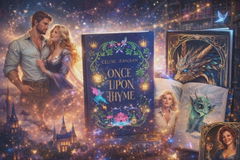
The Complete Special Edition & Reading Journal Collection
✨ See below to select associated goodies and create your own custom book box✨
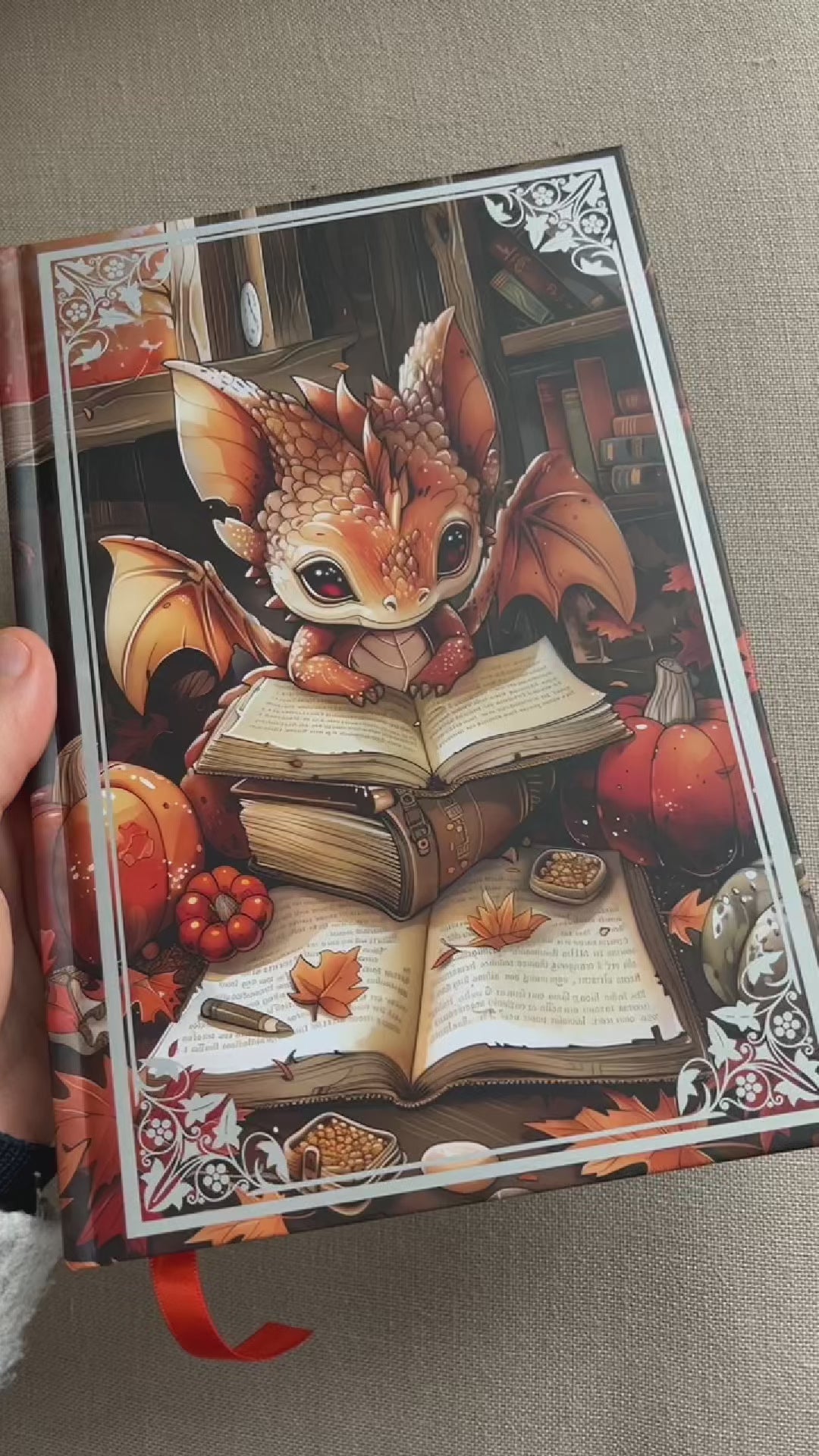
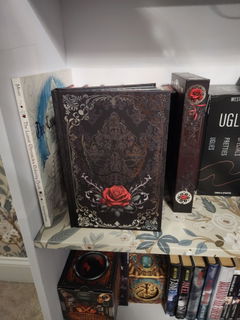
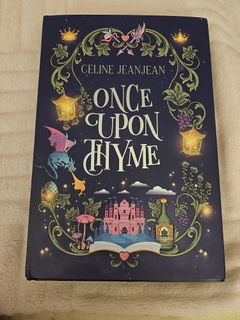
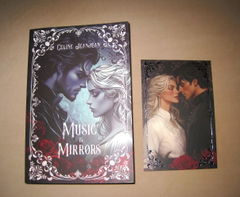
The collection contains books 1 & 2 of the Once-Upon-Thyme series, two quirky fairytale retellings, Music & Mirrors, a gender-flipped Phantom of the Opera retelling, and the full set of 3 book dragon deluxe reading journals.
Once-Upon-Thyme series
If you've ever felt like you don't quite fit the norm, you're going to feel right at home here.
Once-Upon-Thyme is a quirky fairytale world where nobody follows the script. Whether it's the drunk fairy godmother, the snarky magic mirror, or the book nerd wicked queen, none of the characters match the expectations of their role. And every single one of them gets a Happy Ever After as unique and unexpectedly perfect as they are.
Two cozy interconnected fairytale retellings with slow burn, no spice romance. Come run away to Once-Upon-Thyme with us.
Once-Upon-Thyme
Adrianna's fairytale life is not following the fairytale script. Her fairy godmother is drunk and spends her days flirting with the gardener. Her evil stepmother is too obsessed with her garden to remember being evil. Her evil stepsister is, in fact, adorable. And then Prince Charming arrives and inexplicably proposes to her stepmother.
Enough is enough. Adrianna quits the fairytale business. Unfortunately, to protect her home and her family, she still needs a Happy Ever After, which means finding a prince willing to rescue her.
Her plan? Find a dragon. Princes famously love rescuing damsels from dragons.
With her tipsy fairy godmother and a distractingly handsome stablehand in tow, Adrianna blunders her way to an ending no one saw coming, least of all her.
PROLOGUE
Our tale begins quite normally as so many tales do, in Once-Upon-Thyme, that tiny and unusual country. Just like most women’s handbags, it was bigger inside than it appeared to be from the outside. So, while on a map Once-Upon-Thyme was barely the size of a large city, cross its borders and you could lose yourself in an incredible vastness that was riddled with royals, fairies, witches, pretty milkmaids, and courageous shepherds.
Perhaps because its very existence defied logic, attempting to apply reason to Once-Upon-Thyme could only result in the kind of headache normally encountered when disentangling a knotted ball of yarn.
This was a place where shepherds were regularly crowned king, in spite of being utterly unqualified to rule, where medicine was actively discouraged from progressing, because queens were supposed to die in childbirth, and where curses were more prevalent than the common cold.
Our tale therefore begins here, in this odd little country, and specifically within the walls of one of its more lavish palaces. Traditions being incredibly important in Once-Upon-Thyme, certain phrases must always be used when beginning a new story. And it goes something like this.
In Once-Upon-Thyme, there was a prince who had an ardent wish. You could be forgiven for thinking that there was nothing unusual in this—princes are, after all, forever wishing ardently for things—but you’d be mistaken. This is no ordinary tale of princely wishing....
CHAPTER 1
In one of the largest palaces of Once-Upon-Thyme, Prince Charming (for that was, in fact, his name) was in the middle of an embittered battle. Struggling for air amongst the crush of chiffon and tulle, knocking tiaras off heads and setting wigs askew, Prince Charming was attempting as valiantly as he could to find an exit from the hell in which he found himself. Everywhere he turned, another princess, another set of batting eyelashes, another flirtatious smile. Hands reached out for him from every corner, insidiously slipping lace handkerchiefs and favours up his sleeves or down his collar.
Charming ignored the handkerchief assault, for he had now almost reached his salvation: the doors that led out of the ballroom to the balcony that overlooked the garden. With a final and desperate shove of a rotund woman, he managed to expel himself through the double doors and into the cool night air.
The rotund person he had so manfully removed from his way had let out an indignant squawk and was now making such a fuss as to distract and confuse the gaggle of females. Not wanting to waste this opportunity, he hurried down the steps that led to the garden and hid behind a hedge trimmed to resemble a rabbit. He crouched in the darkness, panting, his clothing in disarray.
What Prince Charming desired above all else was to be left in peace. Unfortunately, he was well acquainted with the particular craze that took hold of women when in the presence of a prince—Prince Fever, as he dubbed it to himself—but that didn’t make him any less uncomfortable when confronted with the phenomenon. The affected women went into frenzies of flirting, laughing, mad twiddling of hair, and for some reason he had never been able to fathom, they all went to great lengths to bat him on the arm. The latter was most troublesome since Charming bruised like a peach.
Worse was the fact that the merest flirtatious look threw him into paroxysms of sweating (to say nothing of actual flirtatious comments), so that this latest assault on his person had left his clothing dangerously damp. From behind his rabbit hedge, Charming pulled out the plethora of clandestine handkerchiefs that had hitched a ride in his sleeves, letting them fall to the ground. He found his own handkerchief and dabbed at his moist face.
The cool night breeze helped dry him off, and he lifted his face to it, enjoying this brief moment of peace. The breeze brought him sounds of voices—women calling his name, playfully searching for him among the hydrangeas that lined the balcony. Charming crouched further down. After a while he started to hear impatient sighs and grumbles as it became obvious to the princesses that he wasn’t there.
For a moment he feared that they might push the search to the gardens, but the voices slowly drifted off, swallowed by the faint music that wafted out of the palace doors, until at last some thoughtful soul closed the doors, and the night was blessedly silent once more.
Charming sighed miserably, wondering how long he would be able to stay hidden in the garden this time before he incurred the Motherly Wrath.
A large part of being a prince meant entertaining a bevy of princesses in an endless procession of balls, some masked, some unmasked, with the expectation that he would eventually select one of said princesses to be his wife. His mother would not be swayed on that last point, and since she had decided that his father the King agreed with her in this, as he did in all things, Charming was left with no choice but to comply. But how he was supposed to select a wife from the squawking multitude when he couldn’t bear to speak to them, let alone spend time with them, was beyond him.
A cramp began to crawl up his leg, and he stood up to relieve it, stepping out from behind his hedge.
“Ah, there you are!”
Charming started at the interpellation and, turning, found a woman regarding him severely with her hands on her hips. She was wearing a ballgown, as they all did, but she was somewhat older than his usual pursuers. Quite a bit older in fact. She had grey eyes and a surprisingly hooked nose. That is to say that it protruded more than the button nosed norm he was so accustomed to seeing at every turn.
In fact, there was a distinct lack of prettiness to her features which was highly unusual. Princesses were always pretty, so much so that they all vaguely resembled each other, and Charming had the hardest time remembering who was who.
Charming steeled himself, stoically awaiting the usual assault of flirting, but to his surprise nothing came. The woman was still watching him expectantly. It occurred to him that maybe she was awaiting a reply to her previous statement.
“Yes, here I am,” he said.
The conversational requirements having apparently been met, the woman sprang to life like a toy whose mechanism had been wound up. She marched towards Charming who shrank back reflexively.
“I have been waiting and waiting for someone to show me the gardens. I have heard many good things about your gardener, mainly that he isn’t Cornish, and I’m very interested to see what he has done to your roses.”
While Charming had been bestowed with many qualities at birth, as all princes were, speed of deduction wasn’t one of them, and said speed decreased exponentially when in the vicinity of a member of the female sex. He stared at the woman nonplussed. What was she on about?
“Well, are you going to show me your roses?” she asked, proffering her elbow.
The mist of confusion that had hitherto filled Charming’s mind melted like snow on a furnace. She wanted a tour about the garden! Not only was this not flirting, it was a real and legitimate excuse to stay out of the ballroom. He could have kissed the woman, if propriety, nerves, and inclination had permitted.
Instead, he took her arm and replied, “I’d be delighted to.”
He led her away from the laughter and the music, towards the cool and silent gloom of the rose garden. Never had a sight been more welcome. That was until he realised that as a host escorting a (female) guest through the garden, he should really be offering some sort of commentary on the flowers. Worse, maybe he was expected to rhapsodise about the woman’s beauty in the dark, or some other such nonsense. Charming began to sweat once more. He knew next to nothing about flowers, and how was one supposed to comment on a woman’s beauty when it was too dark to see it? And in any case, she wasn't beautiful.
Thankfully, he didn’t have to sweat for long, as the woman began to monologue at him (or at the night—it was unclear who, if anyone, she was addressing) about the state of the roses. Charming did his best to listen and follow the Unusual Female’s chatter, but he kept tuning off and wandering off into his own thoughts. Every few minutes he would catch himself adrift in reverie, and he would return to the flow of words that poured from the woman’s mouth, much like a man who, despite his best efforts to stay awake, keeps finding himself asleep with his head hanging at an awkward angle.
After a time, it became apparent that no answer was required of him. Not only that, but the Unusual Female didn’t even seem to expect him to pay her any attention.
Charming smiled. What a delightful woman. He followed her through the rose garden, letting her drag him by the arm this way and that, while he ambled pleasantly amongst his thoughts. Just as he reached the conclusion that this was the most pleasant evening he had passed in memory, the Unusual Female anchored herself to a point on the ground, causing him to jerk to an abrupt stop as she still held his arm tightly, thus yanking him out of his reverie.
“Ah!” she exclaimed triumphantly, pointing at a rather haphazard cluster of roses among the bush. “There! There! Nature’s whimsy at its finest. I cannot wait to tell Lowen of this. Would you believe it, he wants all my roses to be symmetrical and evenly distributed, and he proposes to have them enchanted to achieve that end. Have you ever heard anything more preposterous in your life? An enchantment, on my flowers? A little nonsense is to be expected—he is Cornish after all—but that is just poppycock. Don’t worry my dear, I told him. I said, ‘Lowen, you are a gardener of great skill’. He isn’t you know, but I find the best way to deal with the Cornish is to first butter them up with a compliment. Mind you, Lowen is the only Cornishman I know, but he strikes me as particularly representative of his kind—I’m sure you agree. Then I told him, ‘It behoves the professional gardener to know when he is out of his depth. This, my dear Lowen,’ you’ll note how unfailingly polite I remained. ‘This my dear Lowen,’ I said, ‘is one of those instances. Under no circumstance, whatsoever, are we enchanting my roses!’”
This last exclamation was punctuated by the forceful jabbing of her index finger in the air. The gesture startled Charming into retreating as much of his neck between his shoulders as he could, like a frightened turtle. After a couple of blinks he realised that what had ignited the Unusual Female’s passions was either the roses or the gardener, or both, but thankfully not him. By the time he had reached this conclusion, the Unusual Female had departed from the topic of the symmetry of the roses, and she unanchored herself, dragging Charming forward by the arm once more.
“The Cornishman was a whim of my late husband’s you see,” she continued. “You’re wondering why I let him have his way when it is wreaking such havoc with my garden, to say nothing of my nerves. I have to admit, my late husband never interfered with my garden—never. The darling man knew his place was indoors, god rest his soul. So when he told me that his only wish was to have a Cornish gardener, well I couldn’t deny him. He loved their accent, you see. Can’t see why myself—it’s so full of ‘r’s, it’s a wonder they manage to squeeze in any other consonants. Anyway, I let him have this little whimsy. I thought it would be perfectly harmless. Well my dear, what a disaster, I cannot even begin to tell you. Putting up with Lowen’s botanical heresies has frayed my nerves to such an extent…”
Charming tuned out once more, missing the extensive report on the state of the Unusual Female’s nerves, and returning instead to that pleasant state of aloneness with his thoughts. They strolled on from one end of the garden to the other, and two hours passed with what seemed to Charming to be the speed of mere minutes. During this time, he had moved from just thinking this was the most pleasant evening he had ever spent to thinking this was the most amazing woman he had ever met. She brought out the best in him and put him in a state of contentment like no one had ever been able to. That is to say that she left him in peace and neither required him to listen nor respond. He had never felt so happy and at ease. So complete. So understood and appreciated.
Yes, by the time they reached the rhododendron maze, Charming realised that he was utterly, totally, and unequivocally in love.
Finally, he had found the woman for him.
The clock struck ten to midnight as it always did to allow princesses time to leave before their spells, curses, and other enchantments ran out. Charming turned to gaze adoringly at the newfound love of his life. As he did, the fog of adoration parted long enough for him to realise that the Unusual Female was dragging him back to the palace at brisk speed. No doubt heeding the call of midnight. His blunt powers of deduction told him he only had a few minutes before they were back at the ballroom, where he would once again be drowning in feminine charms and would therefore lose the opportunity to ascertain his love’s name along with his ability to speak or think.
For the first time in his life, Charming felt a wave of assertiveness wash over him. He acted. Decisively.
“I say, we haven’t even been introduced,” he said. “I—”
“Oh yes, quite right. Petunia, Queen of Viridi.”
Queen? Charming would have been startled into stopping if the Unusual—that is Petunia—wasn’t still dragging him forward by the arm.
There were very strict rules as to who a prince could marry. Princesses and any kind of pauper were fair game, but the bourgeoisie was wholly off limits (whoever heard of a prince falling in love with the middle classes?).
Charming wasn’t sure where a queen featured on the eligibility spectrum. Of course kings married queens all the time, but that was always after their first wife had died, generally in childbirth, and then they always married evil women, most often witches.
Charming had no dead first wife, he wasn’t a king, and Petunia didn’t seem like an evil woman or a witch, despite her slightly hooked nose (in fact now that he had had time to get used to it, it wasn’t so much hooked as charmingly pronounced.) His brow knotted with concern. This was problematic. But, princes were, after all, supposed to conquer insurmountable obstacles to win their fair ladies. He would simply have to find a solution, which would no doubt require a significant number of hours spent in the library researching the matter.
Cheered by the prospect of uninterrupted time with his precious books, Charming turned to inform Petunia of his plans and of their forthcoming engagement. He was shocked to discover that, unbeknownst to him, his arm had been released, and Petunia had climbed the stairs to the balcony, reaching the double doors that led back to the ballroom. This was so startling a development (no woman save for his mother had ever walked away from Charming before) that he could do nothing but gape as she disappeared into the sea of bustles and petticoats. He only had the time to notice that she had steel-grey hair, a fact the night had kept from him till then, before she was swallowed up by the light and the laughter and the whispers of silk.
Charming remained in the darkness, mulling over the events of the evening. It occurred to him then that he hadn’t had the chance to introduce himself. Did Petunia even realise who he was? No matter, he would simply introduce himself when he informed her of their engagement. For now though, the library awaited.
Snow Is White and the 7 Dragons
It all started with a drunk fairy godmother and a hiccup right when she was naming the baby. And so Snow White was accidentally named Snow Is White.
Beautiful? Absolutely. Interested in princes or Happy Ever Afters? Not in the slightest. Snow would rather describe the weather in excruciating detail. Snow is, after all, white.
Which is a serious problem for Grimhelda, the wicked queen, who has no Happy Ever After to obstruct. So she reluctantly builds the fairytale from scratch, armed with a sarcastic magic mirror, a huntsman whose wit is as blunt as his axe, and seven book dragons.
And along the way, she accidentally falls in love with the prince in disguise...
Prologue
It all started with an unfortunate hiccup.
The whole court, in fact the whole kingdom (it was a rather small kingdom, to be fair, barely more than a town, a couple of small villages, and a bit of forest around it all) was gathered in the Great Hall. A sense of expectation and excitement hung in the air. Breaths were held, and all eyes were riveted on the dais at the back of the hall.
Huge, arched stained-glass windows diffused beautifully coloured light across the crowd. The brightest and most colourful light, which issued from the largest, most colourful circular window, fell on the matching twin thrones.
But that wasn't what the crowd watched so raptly. It was the pretty carved wooden crib in front of the thrones. The crib had been carved, it was said, by the king's own hand during the queen's pregnancy. People whispered about this among themselves. That a king would stoop to carve a crib was proof of his love and devotion to his wife and baby girl.
The king stood beside the crib, one hand resting on the edge of it. He looked at his daughter with a mixture of love and terrible sadness.
The people murmured some more to each other. So tragic how his wife had died in childbirth. Such a beautiful, kind woman, too. So tragic for the king to be left alone to raise the princess. Some wagging tongues said it wouldn't be long before he remarried. A girl needs a mother, after all.
The huge double doors of the Great Hall opened with a dramatic crash that startled every-one into silence. The crowd turned as one to watch the new arrival, and gasps shivered in the air.
Her shadow preceded her, the bright afternoon light silhouetting her. The courtiers and villagers parted before her like the sea opening for a prophet, the only sound the scuffling of boots and the whisper of fabric against the stone floor.
The fairy godmother wore a solemn expression and a blue dress, her russet hair pinned up in a rather haphazard bun. She wafted down the alley made by the parted crowd, her feet a few inches off the ground, occasionally breaking her solemn demeanour to smile benevolently at someone or nod a greeting.
An astute observer might have noticed a slightly smudged quality to her smile.
While she was busy smiling to her right, she lost track of her direction, drifting too far left and bumping into a man. The impact caused her to lose balance a little, but she righted herself quickly, with only a slight pinwheeling of her arms that knocked just the one wig askew.
An astute observer with a keen sense of smell might have noticed that there was an undertone to her perfume. An undertone that was strongly redolent of brandy.
The fairy godmother continued her progress, wafting up the stairs. She missed in her evaluation of the last step and caught her left foot on it, stumbling a little in the air, but this time righted herself without upsetting any wigs—there weren't any within arm's reach.
The fairy godmother landed daintily next to the crib, her feet finally touching the ground. The king looked up at her wordlessly. He nodded once and took a step back, giving his permission for her to perform the birth blessing.
The fairy godmother nodded in response, and she approached the crib.
An astute observer might at this point have noticed the way her feet shuffled when she walked, or the clumsiness of her hands as she reached for the crib.
But there was, sadly, no astute observer present. The crowd gazed at the scene, too entranced by the magic that was about to take place, and the king was too lost to his grief.
The fairy godmother looked fondly down at the baby. A pretty baby, she was. Perfect, smooth skin, with a little puff of black fuzz on her head, and a perfect rosebud mouth, ever so slightly open as she slept. But then again, babies were all pretty, and princess babies even more so.
The fairy turned to the crowd. Now was not the time for cooing over the babe; it was time for pomp and circumstance, for ceremony and magic. For drama and awe and wonder—three things the fairy godmother was rather fond of.
She raised both hands. The crowd looked up as one, following her movement as if she were a puppeteer controlling their strings. She reached out into the air next to her and plucked a magic wand as if it had been floating there the whole time.
The crowd gasped, whispered, and leaned in, craning to see better. The fairy godmother's solemn expression faltered, letting slip her smugness and enjoyment at the attention.
Since an astute observer was lacking, no one noticed the gentle way she swayed on her feet, the unfocused glaze in her eyes, the cloud of brandy vapour surrounding her.
The fairy godmother raised her wand.
"[grandiose] I hereby begin the blessing birth, I mean, the birth blessing."
She stifled a hiccup with her spare hand, the sound echoing loudly in the expectant and silent Great Hall. She cleared her throat gently, not at all put out by this.
"I hereby name this baby..."
Magic gathered thick on the air. No magic in Once-Upon-Thyme was more potent than that of a naming. The crowd held their breath for this most sacred moment in the life of their princess, their future queen, this moment that would determine the princess she would be.
"[grandiose] I name her Snow [hic] White."
The fairy godmother's eyes widened with shock, her reaction matched by the crowd. A stunned silence hung in the air for a couple of heartbeats.
"Snow Is White?" the crowd whispered, confused. "What kind of name is that?"
But the magic had already settled. The name had been pronounced, and it could no longer be undone.
"Er, yes." The fairy godmother cleared her throat, looking uncomfortable. "And, of course, I grant the princess the usual beauty, um..." She thrust two fingers into her corset to fish out a crumpled piece of paper. "Ah, yes. Skin white as snow, lips red as blood, hair black as night." The fairy godmother waved her wand efficiently a few times over the crib. "Sweetness and light, friend of the birds and the small creatures, all who love her in return. Gentle and kind. All the princess things. There we are now. There we are."
She cleared her throat again and glanced about the crowd, conspicuously not looking at the king. "There. I declare this baby named." She carefully avoided repeating the name. "Righty-ho, well, gotta dash. Another baby to name, you know. Things to do, places to be." She turned to the king briefly and patted his hand. "Terribly sorry your wife died, of course. Such a tragedy." She glanced awkwardly one final time at the crowd. "Er, yes. Wonderful. Blessings and happiness on all present."
She waved her wand and disappeared in a puff of blue smoke.
A little beyond the castle walls, on the side of the large dirt road that led away from the castle, the fairy godmother reappeared in a puff of smoke. She coughed and fanned the air around her to dispel the smoke. Then, with a satisfied nod, she dusted off her skirts.
"Job well done," she said to no one in particular.
The afternoon was pleasant, the sun golden, making the fresh leaves on the nearby bushes look bright and vibrant.
"Mirabelle," an eight-year-old girl whispered, poking her head out from behind a bush. Mirabelle jumped, squawking.
"Grimhelda!" Mirabelle pressed a hand to her ample bosom. "You startled me. What on earth are you doing, skulking back there?"
The girl stepped out from behind the bush. She was uncommonly pretty, with thick blonde hair, fine features, and large grey eyes lined with thick lashes. Womanhood wasn't yet on her, and already it was clear she would be devastatingly beautiful as an adult.
"I wanted to get a look at the naming, but I'm not allowed to go in there."
"Of course not. But you'll have plenty of time to nose around once you live there."
Grimhelda bit her lip and glanced at the castle. "What's he like? The king?"
"I didn't get much of a chance to talk to him, but you know, the usual. Kind, beset with grief, dotes on his daughter, mourns his wife." Mirabelle hiccuped, not quite managing to catch the sound in her left fist.
"I can't believe I'm going to have to marry him." Grimhelda made a face. "Yuck. He's so old."
"You're not marrying him for another ten years," Mirabelle reminded her. "And he's only twenty-three now, which is far from old. Take it from me. I thought he was pretty handsome, grief notwithstanding..."
"I wish I was never marrying him. I don't want to be married."
"Well, at least wicked queens are never married for very long."
"That's true." Grimhelda smiled. "And the baby? What's she like?"
"Hard to tell when they're that small. I expect she'll be very normal for a princess. Sweet, patient, kind. You know, the usual."
"And her name?"
A flash of discomfort skittered across the fairy godmother's features. "Mind your own business," she sniffed. "You're not married into that family yet."
"I'm going to be in ten years, so I might as well find out now the name of the girl who's going to be my"—Grimhelda shivered—"stepdaughter." She made a face again. "Ugh. I don't want a stepdaughter. I don't think I ever want children."
"Well, you can find out your future stepdaughter's name in due course," Mirabelle said primly. "Anyway, little girls shouldn't pry."
“I can find out by myself,” Grimhelda countered. “I’ve got my own magic, remember, since I’m to become a wicked queen.” She frowned in concentration for a moment, and then her eyes widened with confusion. “Snow Is White? That’s really what you named the baby? What kind of name is that?”
“The name her mother wanted for her,” Mirabelle replied defensively.
Grimhelda raised an eyebrow. “You’re telling me the late queen wanted to give her daughter a sentence for a name, complete with verb?”
Mirabelle hiccuped before she could reply. Grimhelda sniffed and then gasped.
“You’re drunk!”
“Am not. I just had a bit of brandy before the naming ceremony, that’s all. I always have a snifter of brandy before an important moment. To steady the nerves, you know.”
Grimhelda rolled her eyes. “You’ve never been nervous a day in your life.”
“I’ll have you know that I have a delicate disposition with nerves that are easily frayed and that require care.”
“Ha, you’re as delicate as I’m old.”
“I’ll thank you not to talk to me like that,” Mirabelle snapped. “You’re eight; you’re not supposed to sass fairy godmothers.”
“I’m not a normal eight-year-old,” Grimhelda replied. “Plus, I’m supposed to be unpleasant—I’m destined to be a wicked queen.”
“Be that as it may, I don’t answer to you. I named the baby, as I was supposed to, and that’s all there is to it. Now, I’ve got to dash. Another baby to name. Um...”
She fished the piece of crumpled paper from her corset once more.
“Ah, yes. Adrianna - Better run.”
“Wait. You’re just going to leave me?” Grimhelda asked in a small voice, all her previous confidence and sass gone.
Mirabelle paused and gave the girl a kindly look, reaching out to pat her cheek. “Don’t think too much about your future as a wicked queen, my sweet. Enjoy these years you have for now, when you have your freedom, before the storylines start to truly set the wheels of your life in motion.”
“I wish I didn’t have to become a wicked queen,” Grimhelda whispered. “I didn’t ask for this.”
Mirabelle leaned over, her breath rich with the smell of brandy. “If you want to know what I think, better to be a wicked queen than a princess. They tend to live longer, for one, and you get to do what you want for most of that time. If you were a princess, you’d have to be locked in a tower or made mute or something. And as a wicked queen, once the prince comes along and boots you out of the castle, you get to live out your days peacefully retired, away from all this nonsense."
Grimhelda nodded. "Yes, then I can have a small cottage. I can fill it with books, get a pretty tea set and a cat, and I'll be happy."
"Exactly. The wicked queen is an unpleasant but short interlude before you get there. Now, pet, I really have to run. I'm going to... What's it called again? Ah, yes, Veridi Castle. They're expecting me for more than just a naming. I'm to be the fairy godmother in residence."
"You're staying there for good? Why can't I have a fairy godmother to watch over me?"
Mirabelle sighed. "Wicked queens don't get a fairy godmother, you know that. That's why you have your own magic."
"But that means I'm all alone." Grimhelda's eyes brimmed with tears.
Mirabelle glanced around, making sure they were far from prying eyes. Fairy godmothers weren't supposed to comfort wicked queens in waiting, after all. "Tell you what, I'll come visit you regularly, then it will be like you do have a fairy godmother. How does that sound?"
The girl brightened at that, and Mirabelle grabbed her into a hug. "Aw, my pet, fairytales aren't easy."
"Fairytales suck." Grimhelda's voice was muffled against the fairy's shoulder.
"Unfortunately, we don't have a choice but to live by them." Mirabelle stepped back. "And now I really have to dash. I shouldn't have booked two namings back to back. Bad enough that I—"
"Screwed up the first one?" Grimhelda asked, grinning.
"Hush now."
"Don't worry, I won't tell anyone."
"Thanks, pet."
Grimhelda gave a wicked grin, a flash of the queen she would become. "People are too stupid to think for themselves and notice, anyway."
Mirabelle frowned. "You shouldn't say such things."
Grimhelda shrugged. "Well, it's true."
Mirabelle patted her cheek. "I'll be back to see you soon." When Grimhelda's eyes filled with worry again, Mirabelle paused. "And once your storyline truly starts, once you marry the king, if you need me, you can call for me, and I'll come to you. It will be fine, Grimhelda. All will work out. Fairytales always do."
And the fairy godmother winked out.
Chapter 1
The knock at the door was discreet, deferential. “Your Royal Highness?”
Grimhelda was sprawled across her bed, still in her nightdress, a thick book open in her hands. Several piles of books were scattered across the foot of her bed, with more on the floor. The room was opulent, with silk drapes at the windows and gilding on the furniture. An inordinate number of mirrors covered the walls, with an additional triptych at the vanity and a selection of silver hand mirrors on the nightstand.
Grimhelda didn't like having so many mirrors, but it couldn't be helped. A wicked queen, especially one as beautiful as her, was supposed to preen and be obsessed with her appearance. Well, in truth, a part of Grimhelda enjoyed the mirrors, just as she enjoyed the attention, the looks. Being beautiful was a nice thing, after all. Who didn't want to be stunning?
But she also knew her looks would get wrenched away when the Happy Ever After came, so she was trying to control the vain part of her. The Happy Ever After meant she'd be forced to leave the castle as an ugly spinster, a prematurely wrinkled old woman, to go live out her days in solitude in a little cottage lost in the woods, forgotten and irrelevant.
But Grimhelda still held on to the plan she'd made as a child. The cottage would be filled with books. It would have a cat—black, of course. There would be a nice tea set. There'd be shelves with dried herbs and spices and a small fireplace. It would be a cozy haven, a place she could read all day, every day, without anyone bothering her. Grimhelda's plans for retirement sounded blissful—far better than being a beautiful, wicked queen forced to rule over a kingdom she didn't want.
The knock at the door came again. Grimhelda turned the page, ignoring it. The knock came a third time, a little more insistent this time. “I know you're there, Royal Highness.” The last was added in irritatingly polite and gracious tones, the kind that set her teeth on edge.
Grimhelda made an angry huffing sound, throwing herself back on her bed, book against her chest.
“What, Bradford?” she snapped.
The door opened, and a small, neat man entered. He wore a sober midnight-blue suit with a discreet gold pin at his breast to indicate that he was her chief adviser. His hair was hidden beneath a tidy grey wig, and the pouches beneath his eyes spoke to the late and sleepless nights he spent poring over the finance ledgers. Grimhelda did an excellent job of squandering what little money the kingdom could scrounge from the perpetual winter.
“There’s an issue with the village mill,” Bradford said.
Grimhelda sighed. “There’s always an issue with the village mill.”
“It’s all the snow and ice,” Bradford said carefully.
“Yes, yes. I know. The snow and ice that descended on the kingdom ever since I became wicked queen.” She threw Bradford a look. “I wasn’t supposed to rule for this long. I was supposed to swan in, be beautiful and vapid and mean for a few years. Then Snow was supposed to meet a prince, get married, Happy Ever After, all the snow and ice disappears, and I get booted out of the castle and into retirement.”
Bradford cleared his throat uncomfortably. “Yes, Your Royal Highness.” He never liked it when she referred to things in such a straightforward manner.
“I don’t want to rule, Bradford. In fact, I’m not meant to rule. I’m meant to say things like ‘less is more’, or ‘thin is in’, or ‘if they can’t make bread, then let them eat cake’. Preferably while wearing a negligé that’s worth more than a year’s income for a villager.”
“Yes,” Bradford said.
“I’m not supposed to be the good one,” Grimhelda added pointedly. “I’m the wicked one, and I’m very good at it. It’s not my fault the good one is so useless at playing her role.”
“Yes,” Bradford said.
“It’s not my fault that my reign is lasting way longer than it should.” Grimhelda was growing annoyed. “I didn’t want this—nobody wanted this.”
“Yes,” Bradford said.
“Oh my goodness, man!” She tossed her book aside, throwing her hands in the air. “Stop harassing me in this way. Fine, fine! You win. I’ll go sort out this mill issue. But you better make sure nobody knows about it. If anyone hears that I fixed the mill, I will wring your throat myself.”
“Absolutely.” Bradford’s small smile was ever so irritating.
“I mean it, Bradford. If I hear the slightest good thing said about me, I will roast your feet over the fire.”
“Of course.”
“I will douse you with honey and feed you to the ants. I’ll turn you into a flea and send you to live on the back of a cantankerous swamp beast. I’ll turn you into a toad and have your pustules squeezed daily for poison to put in my potions.”
“You can rest assured, Highness, that I won’t breathe a word of this to anyone.”
“I hope not,” Grimhelda groused. “I worked damn hard to build my reputation as a wicked queen, and it’s not for people to suddenly start thinking well of me.”
“Of course not.”
“In fact, after I’m done, you should tell the people that the queen has spent all their taxes on anti-wrinkle cream.”
“I will say that to the exact word. Might I suggest the addition of a facial made of goblin snot?”
Grimhelda wrinkled her nose. “Ew! Is that a thing?”
“Apparently so. I’m told of a beautiful witch who’s also trying to keep her looks, and she swears by them.”
“What do you mean, ‘also trying to keep her looks’?” Grimhelda shot an automatic look at the nearest mirror to check her beauty hadn’t suddenly collapsed like a bad soufflé.
But all was fine. Her thick blonde hair was a shining cascade down her back. Her skin was smooth and firm, her grey eyes wide and crystalline.
“Err, I mean that unlike your beauty, which is completely natural, she’s having to resort to all kinds of concoctions.”
“Well done, Bradford, good save.” She gave her mirror a quick smile to check her teeth were still nicely white and even.
“Thank you, Highness.”
“And yes, you may tell the people that I slather goblin snot on my face.”
Grimhelda turned to grab the book she’d tossed away earlier and flicked back to her page, reassured that all was still well.
“Of course. So...does that mean Your Highness will take a look at the mill?”
Grimhelda rolled her eyes to the sky.
“Your Highness did say—”
“Yes, yes.” She shut her book with a huff. Such a good book, too. It took place in a tropical city, and the main character was an assassin with a fear of blood. She found him rather entertaining.
She shuffled to the edge of her bed and clambered down. It was a tall bed—not as tall as the pea princess’s, of course, but still tall enough to be as imposing as was needed for a wicked queen.
Bradford beamed. “Thank you, Highness. You’ll also be pleased to hear that Snow Is White has a visitor.”
Grimhelda spun around, her nightdress whirling around her. “A visitor? What visitor? Is it a prince?”
“...Yes.”
“And you waited this long to tell me? Bradford! What is wrong with you? This could be a potential suitor!” She sprinted out the door, her book entirely forgotten.
“What about the mill?” Bradford called behind her.
“It can wait!” Grimhelda shouted over her shoulder as she rushed out into the corridor. “In the meantime, just tell the villagers that thin is in and to eat cake!”

If you want to create your own custom book box, simply select whatever goodies you want from the sections below:
PROLOGUE - IGOR
Igor runs through the opera house’s secret passageways. Running silently, quietly, secretly. Just like the Mistress ordered.
How large is his kingdom. How wide, how full of nooks and crannies and peepholes.
But no, that isn’t right. It is not Igor’s kingdom, but the Mistress’s, and Igor is just her humble servant. Yes, he is.
He is lucky—lucky—that she allows him to enjoy the run of her domain.
He slithers through the passage. It’s so narrow, anyone else would get stuck. But the Mistress made him well. Made him perfect for this.
Eyes that see well in the dark. The dark of the opera house’s secret passageways. Long arms, strong fingers—good for climbing. Shoulders narrow, perfect for squeezing into small spaces. And flexible—flexible like rubber.
Igor runs a hand along the rough stone of the passage’s wall. Sometimes he has to turn sideways to squeeze through the narrow gaps. He likes these moments best of all, because they are a reminder that only Igor is fit for this job.
Only Igor can be depended on to be the Mistress’s eyes and ears.
And it is a reminder of how much thought and care the Mistress put into the making of him.
Igor almost laughs with the joy of it until he remembers—he must be silent. He must move silently, quietly, secretly. Secrets must always be kept.
He peeks out through a peephole. The workmen are there, doing their work. They bang and cut and saw. They bring to life the Mistress’s vision.
The Mistress told him that the pharaohs of Egypt had great tombs built, and when the tombs were finished, they killed all those who had built them so no one would know the tombs’ secrets.
This is not a tomb, but the opera house has secrets, and Igor must make sure its secrets are kept. Secrets, he hisses inside his mind.
He slithers away from the peephole, checking on the other lot of workmen. He does this every day, without fail. Check on them, check on their work, go down below and report to the Mistress. Then back to the surface, check on the workmen, check on their work, return below to report.
And all the while, he is free to run through all the passageways. Run, run, run.
Is anyone lucky enough to have a life as good as Igor’s? Igor doesn’t think so.
Once he has finished checking on the work, he heads back. But when he hears a voice, a voice in a place where no voice should be, he hisses in shock and anger.
“Hey, did anyone know there are stairs going down here?” a workman calls out. No one replies.
Igor hisses again. He reaches the corner ahead and looks out carefully. A bit of luck—it doesn’t seem that anyone has heard the workman.
Yet.
Quickly, softly, secretly, he slides through another side passage and steps out right by the entrance to a non-secret part of the opera house. First, he picks up a hammer that was left behind, then he slides shut a panel that should never have been opened.
There. Now no one will see, and Igor will make sure no one hears. He flexes his fingers, the strong fingers that the Mistress gave him.
Then he creeps around the passages until he is behind the workman on the stairs. The man has begun to climb down. Down, down, down. “Hello?” he calls every so often.
It is all right, no one will hear him so deep. The secrets will be kept.
The stairs are large and made of stone. The stone is old and worn and smooth. The man’s footsteps are loud because he wears boots.
He doesn’t hear Igor, because Igor’s feet are bare. They are always bare. Bare feet, large feet, toes that can curl—all the things the Mistress gave him so he could climb better.
Softly, secretly, silently, he follows the man down the stairs.
The stairs go down for a long time, but Igor is patient. Time means nothing to him.
At the bottom, the steps open out onto a stone platform. And there, beyond, is the lagoon. The water is flat and smooth as glass. And it is green—green as jade, green as grass, green as… The man steps up to the edge of the platform where Igor has tethered his gondola.
The man pushes the gondola with one boot. The movement sends ripples all through the water, disturbing the glassy surface.
Igor represses a hiss. This is his water. His water of glass, his water green as jade, green as grass, green as emeralds. The man has no right to disturb it.
Lucky that workmen have tools and that this one left a hammer behind. Igor clenches his hand hard around the hammer’s handle, feeling the strong wood against his palm.
He approaches the man from behind, his feet silent on the stone. He swings once. Then he swings again, and again. Just to be sure.
He carefully places the hammer in the gondola and then drags the man into it. It rocks dangerously from side to side, but Igor grabs the pole he punts with and steadies the gondola.
Then he untethers it and pushes out. The gondola cuts through the water, as smooth as scissors cutting through silk. Green silk. Green as jade, green as grass, green as emeralds.
Across from the lagoon is the start of the maze with its walled canals.
When Igor is far enough into the labyrinth, he stops and heaves the man out of the gondola and into the water. It makes a big splash.
There is blood all over Igor’s gondola. He frowns at it. He’ll have to clean that. The Mistress likes things to be clean.
But for now he waits, crouching down in the middle of the gondola, watching the dead man beneath the water. The green water.
At least, Igor thinks the man is dead. Death confuses him. He was dead, after all, and then the Mistress made him alive. Or rather, the various parts of him were dead, and the Mistress brought them together to make Igor, to make him live.
Does that mean the workman might also become alive again? Igor isn’t sure. He can’t take the risk, though, not now that the man has uncovered a secret of the opera house.
Igor can’t risk the man finding out about the Mistress.
So he waits, hammer in hand, patiently, to make sure the man doesn’t come back to life.
Igor is patient. Time means nothing to him.
CHAPTER 1 - ADA
“Is everything all right with your hair, my lady?”
Ada Byron looked at her reflection in the mirror. Her blond hair was piled up on top of her head with a decorative something stuck to the side of it. Her shoulders were bare, and around her neck hung a large teardrop diamond. A present from her father.
In truth, she had no idea about the state of her hair. However, she knew that feedback was important to her maid, Bridget, who hovered behind her.
It had taken Ada a long time to puzzle this problem out. If she always told Bridget that her hair looked great, the maid grew anxious that something was terribly wrong, something that Ada wouldn’t say. It had once got to the point where Bridget, in tears, had asked if Ada was thinking of firing her.
Absolutely perplexing.
But if Ada picked imaginary faults with her hair or clothes every time, that also caused Bridget to become distressed. So Ada had devised a mathematical algorithm to establish the days on which she should be dissatisfied with her appearance. She used a distribution coined by Simeon Poisson—the Poisson distribution. She’d had such fun working out that algorithm.
What Ada wouldn’t give to have something named after her. A theory or invention of hers. But nothing was ever named after women. Instead, women sat in front of pale blue vanities, surrounded by hairbrushes and vials of perfume, and talked to their maid about their hair.
Nothing in Ada’s bedroom was her choice. Not the Wedgwood blue and gold silk canopy above the bed, not the matching wallpaper, and certainly not the pale blue furniture that looked like it belonged in a macaroon shop.
None of this suggested a scientist, serious or otherwise. Ada’s beloved books had to be hidden out of sight in a cupboard, the only way they were tolerated. And it was best to ensure Mother never saw her notes, although Ada could thankfully rely on Bridget to keep quiet about them.
Young ladies of breeding were Not Allowed to take an excessive interest in Mathematics and the Sciences. And any interest seemed to qualify as being in excess, something Ada had also taken a while to figure out.
She quickly went through the calculations and established that today was a day for her to be happy with her hair. She smiled at Bridget’s reflection in the mirror. “It looks beautiful.”
Bridget beamed with pleasure. “I’m so glad you think so, my lady. Your mother told me that tonight was an important evening, and that you had to look your best.”
At the mention of the evening awaiting her, Ada’s smile faded. She made the noncommittal noise in reply. This was the noise she used when she either couldn’t figure out what reaction she should have, or when she knew that her natural reaction was Not Allowed according to her Code of Human Interaction.
She returned her attention to her notes. Poisson’s distribution was a far more comforting topic to focus on—it went without saying that Bridget had no idea the figures neatly written out on the paper pertained to her hairdressing efforts.
A soft knock at the door made Ada look up. The housekeeper entered. Mrs Carson was Ada’s favourite person in the house. She was a stout woman in her fifties, with greying hair and kind, soft features. Ada had never seen her wear anything but black, and when she moved, the ring of keys at her belt jangled, announcing her arrival.
“A note for you, my lady.” She brought it over, the white envelope resting on a slim silver tray. “I kept it aside from the rest of the post. I thought you’d prefer your mother not know about it.”
“Thank you, Mrs Carson. That’s very kind of you.”
The housekeeper said something else, but Ada didn’t hear. Her senses were entirely occupied by the white envelope she now held in her hands. Her heart was beating hard, the thumping loud in her ears. Heat was rising up her neck. The reactions of adrenaline freshly released into her body. Knowledge didn’t make the sensation any less visceral.
She licked her lips and took a breath to steady her nerves. Then, carefully, she slid her finger beneath the sealing wax and cracked it open.
She scanned the letter quickly. The heat that had risen up her neck to her cheeks disappeared abruptly, replaced by ice. The letter weighed no more than a feather, and yet it suddenly seemed heavier than lead in her hands.
Nothing. Nothing was mentioned about the theory she had submitted to the British Scientific Journal. Nothing of all the extensive work and research she had done. To say nothing of all the complications, since her mother couldn’t know about any of it.
Of course, the journal wouldn’t know that, but the rest... Her theory was good, and her results had been conclusive. And yet the response she held in her hand only spoke of how neat her handwriting was, how commendable her attention to detail when she had copied the text.
Copied? This was original work.
The letter went on to confirm that they had found no errors, so she had obviously done a perfect transcription.
Ada clamped her lips into a thin line. The reason they had found no errors was because she had checked the theory, not because she had copied it from a book. How did they not realise that this was new work?
Instead, they assured her that as soon as they had need of a secretary, they would contact her, and they assured her of their best wishes.
A strangled sound escaped her.
“My lady?” Bridget asked, sounding alarmed.
Ada realised she had completely forgotten that she wasn’t alone. Mrs Carson had obviously already left, but Bridget was still here.
A fit of anger in front of witnesses was far too dangerous a thing—that led to the doctors being called and words like ‘Hysteria’ being mentioned, or worse, whispers of ‘Child Psychosis Can Result In Unstable Adults’, and mentions of the ‘Institution’. Ada knew she was neither hysterical nor psychotic, but she’d never been able to convince the doctors of either. Nor could she explain why she didn’t seem to function like everyone else.
With some difficulty, she reached for the pencil on her vanity. She grasped it tightly in both hands, crumpling the letter around it. The Anger Management Protocol worked well, and she knew she could rely on it.
Rudolf Clausius’s first law of thermodynamics stated that energy could not be destroyed, but it could be transformed. Ada found this worked equally well for emotions. She couldn’t destroy her anger or make it disappear.
Instead, she could transform it. She squeezed the pencil until her nails were digging into her palms. It was like a safety valve, letting out excess steam in an engine.
The pencil snapped.
“Oh dear, I seem to have broken my pencil,” Ada said, the words coming out jerkily. “Bridget, would you get me another?”
The maid bobbed and walked out briskly. That was also part of the Anger Management Protocol—it gave Ada a few precious moments alone to gather herself. She turned to face the clock hanging above her mantelpiece—another gift from her father. It was a miniature replica of Prague’s famous astrological clock. She took deep breaths, following the ticking of the hand marking the seconds. She rubbed her earlobes between her thumbs and the sides of her forefingers, rocking lightly. Doing so was soothing, but it could only be done when she was alone.
By the time Bridget returned, Ada knew she would be calm again. Her Anger Management Protocol had been honed until it had a hundred per cent success rate. Looking at the clock helped, too. It reminded her that her father, Lord Byron, also knew what it meant to be different from everyone else. To be misunderstood, misrepresented.
By the time Bridget returned, Ada was once again composed.
* * *
Finally, it was time to go. Ada could delay no longer. Still, she sat at her vanity, staring down at her gloved hands.
“You’ll have a great time, Miss,” Bridget said encouragingly.
Ada nodded and made the noncommittal noise. A knock at the door, this one the bearer of bad news.
“Her Ladyship requests that Lady Ada come down, so they can get ready to leave,” a footman announced.
“You’ll have a great time, and you look beautiful,” Bridget repeated.
Ada didn’t have it in her to attempt a smile in response. She headed silently downstairs.
“Ah, there you are,” her mother said. Lady Byron looked Ada over critically. “Good. You look presentable tonight. Bridget, get my daughter’s wrap.”
Lady Byron was fashionably doll-like, her face framed by blonde ringlets, her skin pale, her eyes round and blue. Ada got her colouring from her mother, but her features were all from her father.
Ada had heard it said that her mother was always dressed in the absolute latest fashion. All she knew was that her mother’s dresses were complicated, with much ribbon, lace, and gemstones decorating them.
The carriage ride over to the ball took place mostly in silence.
“Now, try to be charming tonight,” Lady Byron said when they were nearly there. “God knows that’s difficult for you, but try. It’s bad enough that we have to contend with your father’s latest scandal, but with your…disposition, we really have our work cut out for us. Don’t say or do anything strange, do you hear me?”
“Yes, Mama,” Ada mumbled. She kept her eyes trained on her gloved hands. Her mother always wore an ugly expression any time Ada’s difference was mentioned.
“And Ada, let me be clear. If by some miracle we are able to arrange it so that someone else proposes to you, you will accept this time.” She paused. “Do you hear me?” she added loudly.
Ada could feel her palms sweat at the thought. “Yes, Mama.”
Her mother often confused Ada’s difficulties in navigating interactions with difficulties in hearing. When Ada struggled, Lady Byron simply spoke more loudly, which paradoxically made it even harder for Ada to navigate the situation.
Ada’s Code of Human Interaction made it clear that the easiest way to deal with people outside of Bridget and Mrs Carson was simply to respond yes to everything.
The only notable exception to that being, obviously, the time she had replied no to a marriage proposal. But any other response had been impossible. The whole stress of the situation had been awful—having to break her Code, having to deal with the pressure of saying ‘No’ to someone, having to deal with her mother and the consequences of her rejection.
Ada had broken down, lapsing back into behaviours that were Not Allowed. In front of her mother and the servants. The doctors were called. They’d poked and prodded her. Locked her in her room, and for a short while even tied her down to the bed.
“She was a Child Psychotic,” they whispered.
“Return of Hysteria,” they murmured.
“If continued lapses occur, we may have to consider moving her to an Institution.”
Of course, they made it worse, causing her so much distress she had struggled to manage her agitation. It had taken her enormous force of will to overcome the stress and return to Allowed behaviours only.
And all of that because a man had proposed marriage to her, which was impossible for her to accept. Ada knew she had to ensure no one else proposed to her ever again.
“…because of your father’s latest scandal,” Lady Byron was saying. She drew a shuddering breath, looking out of the window. “It’s his bad blood that causes your problems, I know it. If I had married someone decent, I’d never have bred a daughter such as you.”
“Yes, Mama.”
Lady Byron shook her head. “After all, I have done for you, I still can’t believe you had the nerve to turn that young man down.”
“Yes, Mama.”
“Do you really think it’s fair for me to be saddled with your…your…difficulties for the rest of my life? I already have to deal with the consequences of your father’s behaviour. When am I to find happiness, a life free from scandal? When you are married, that’s when.”
“Yes, Mama.”
Ada drowned out the rest of her mother’s words. She had never explained to her mother that marriage was impossible for her. That her only option was spinsterhood.
She had to hope that she’d make it to an age where she would be considered too old, and therefore ‘on the shelf’, so she would finally be safe and maybe even left in peace.
CHAPTER 2 - ERIC
Eric Asher looked out of the window, taking his time. Rushing at this point could be disastrous. He gazed over the neat street outside, bordered by large white houses, each one with a wide entrance flanked by columns. Sleek carriages rolled past to the gentle rhythm of trotting horses. Women in expensive dresses waved greetings at men in flawless top hats, which they raised in answer.
This was not his world, had never been, and nor would ever be. He was a parasite, no better than a flea or tick, sucking what lifeblood he could before he was removed.
But today was not the day he’d get tossed back outside. He’d make sure of it.
He composed his expression and turned back to face the room. Clenched his jaws and allowed pain to show in his eyes, just enough to suggest devastation but make it look like he was trying to hide it.
He caught Lady Eleanor’s gaze. Her own eyes widened, and Eric experienced the quick flash of satisfaction a snake must feel when it has hypnotised its prey. Lady Eleanor was middle-aged and yet dressed as ridiculously as the room was decorated.
In fact, she fit so perfectly, Eric wouldn’t have been surprised to discover she had been born of the room itself. Everything was floral. The wallpaper, the upholstered furniture, the lady’s dress. It would have looked overly sweet on a ten-year-old girl and had no business on a woman in her fifties.
Sickly fragrance from the large porcelain dish of pot-pourri clung to the air, and it would be worse when Eric was close enough to Lady Eleanor for it to mix with her perfume.
Gold accents on the wooden furniture added a gaudy highlight, just to make sure every surface was overdone and clashing to the eye. Everything in the room jarred apart from the beautiful, gleaming, grand piano in the corner, its lid propped open. Eric could just make out a tantalising glimpse of the ivory keys, like a coy smile.
But there would be no piano for him today.
“I… I’m so sorry,” Lady Eleanor whispered. “I simply can’t do this anymore.”
Eric allowed a low growl to rumble in his throat. “Eleanor.” His voice sounded heavy and strained. Just right.
Her hands trembled slightly.
It was the signal he’d been waiting for, and like the snake darting to bite his prey, he sprung forward, crossing the space between them in two large steps.
He took her hands in his. Hers were plump and soft, having never known work. The skin was growing loose, middle-age robbing it of its elasticity. He could see the small creases in her neck where the rice powder that she applied so dutifully collected. Her eyes were a watery blue, all the more so now because she was on the verge of tears. Her mouth was small, her chin weak.
And yes, there it was, the stench of her perfume. Eric could taste it in the back of his throat with every breath he took.
But he didn’t mind any of it. Would have gladly put up with far worse. Not only did she pay well, she sometimes played the piano for him, although her late husband had apparently been the truly musical one of the family.
But still, she played well, and she enjoyed his singing. The days when they shared music were by far the best.
Lady Eleanor’s ample bosom heaved as she gulped in a breath against the strain of her far-too-tight corset. “If anyone were to find out, the scandal...”
“Let them talk,” he said, keeping his voice low so that it sounded almost muffled. “Talk cannot keep us apart.”
Eric crushed her to him, covered her mouth with his. He had long ago honed his kissing technique down to a fine science, depending on the emotion he needed his clients to feel.
He carefully went through the motions. Desperation. Desire. Pain.
When he broke away, she was breathing heavily, her hair and dress in disarray, her cheeks flushed.
This wasn’t the first time Eric had needed to navigate her through her fears of scandal and discovery, although he was starting to suspect that a perverse part of her enjoyed it.
That was absolutely fine—he would reenact the scene for her as often as she wanted, so long as she kept paying him after.
“Oh, Eric,” she sighed.
The next signal. Eric swept her up into his arms—which was no small feat, given how much she weighed. He didn’t keep himself fit only to look good naked.
He carried the Lady Eleanor out of the sitting room and up to the usual bedroom where he would truly earn his fee.
* * *
Once he was finished, Eric departed discreetly, leaving the lady asleep and satisfied. He walked briskly, the plush carpet underfoot muffling his footsteps.
He was intimately familiar with the layout of the house by now, and he quickly found the servants’ stairs.
No carpet here, his polished shoes clipping against the hard surface of each step as he took them two at a time.
“Finished already?” a maid asked, giving him a saucy look. “Sir,” she added with a cheeky grin.
Seduction wasn’t only useful for the rich who paid. It was always helpful to have the staff on side. Such a basic level of seduction Eric could do in his sleep.
In fact, he didn’t need to do anything. His black, slightly curling hair and warm complexion added a darkness to his dashing looks. He only needed to smile to make women giggle.
He shucked the maid under the chin with a finger and gave her a wink. She blushed and laughed, and he felt her staring after him as he walked on.
It was so easy.
“Won’t you take a pastry, Mr Asher?” the cook called from the kitchen, hurrying over.
She was as round as a plum, with cheeks as red as cherries. Any time Eric saw her she always appeared from a cloud of steam, flour in her greying, curly hair which was forever escaping her white bonnet.
Eric took the proffered pastry, which was wrapped in a bit of wax paper. He gave the cook his first genuine smile of the day and kissed her on the cheek. “Where would I be without you?” She was one of the few he genuinely liked and didn’t have to pretend with.
She squawked and laughed and shooed him away, her hands fluttering at her hair.
Eric continued towards the exit. Immediately to the left of the back door was the room he used for changing. As usual, Williams the Butler waited for him there.
“Your money,” he sneered.
Eric took it. “My thanks.”
“Have you no shame?” the man hissed.
“None whatsoever,” Eric replied coolly. And he wasn’t lying.
“What you do is the devil’s work. One day, your sins will catch up with you.”
Eric shouldered past him. “You remind me of my father.”
And that wasn’t a compliment.
He entered the little room, going to stand next to the bag he had left there earlier. He didn’t bother closing the door, beginning to strip off his clothes.
“Were you hoping for a look, Williams?” He raised an eyebrow at the butler. “I might have to charge for that.”
The man made a strangled, flustered noise, and slammed the door shut.
The amused expression on Eric’s face fell as rapidly as his clothes. He carefully folded each item, smoothing out any creases, before he began putting his normal clothes on.
He never even wore the shoes outside.
Eric had one good set of clothes, and they were worth their weight in gold. Nothing was more anathema to seduction than poverty.
Wearing his fine shoes in the street would lead to the leather receiving cuffs, to the heels wearing down. Sweat and dirt would yellow his fine white linen shirt. Wearing the good jacket beneath his coat risked crumpling the fabric, and the coarse coat would rub against the finer fabric and wear it down more quickly.
Once he was dressed in his regular clothes, he looked like what he was—a man who had been born of a very lower middle class family and now teetered on the edge of poverty.
Lady Eleanor wasn’t truly a lady. It had amused her when Eric starting calling her that, so of course he had made sure to continue. Her husband had been a successful merchant, which placed them both at the top of the middle-class. Although, of course, the gulf between the aristocracy and the middle-class was far greater than between the lower middle and poverty.
As Eric was well aware, the divide between the lower middle-class and poverty was little more than a thin line. A thin line on which he was currently precariously balanced.
He carefully wrapped his work clothes, including the shoes, in waxed paper, keeping the waxed side facing out to repel any rain.
Then he wrapped the parcel in a cotton cloth and put the whole thing into his bag. He shrugged on his coat, which was a couple of sizes too big. It provided just the right amount of space so he could close it over his bag, keeping it cradled against his chest as if it were a baby.
A baby would have been less fragile cargo—getting it wet wouldn’t result in it smelling damp the following day.
Eric opened the door to his changing room and, in one smooth movement, without pausing to glance back at the house, he slipped out of the back door.
He never liked to hang around once he was out of his work clothes. Of course, the staff knew what he was, what he did, but all the same, he didn’t like to break the illusion he had woven around himself, not even for them.
It was one thing for them to know, it was another to be faced with reality.
* * *
Lady Eleanor’s house felt like a distant memory as Eric ploughed deeper into London. Gone were the scrubbed streets, the white houses, the genteel carriages. The buildings here were of dull, brown brick. Carts clattered past, coal dropping out the back, quickly snapped up by snotty-nosed children in ragged clothes.
The sky was dark with rain clouds, coal smoke, and the approaching night. Everyone was dressed in various shades of drab or black. Faces were pinched with stress, or bitterness, or frustration. Coarse voices cried out, shouting arguments or yelling the prices of goods they were trying to unload before closing up for the day.
And then it began to rain. No great surprise for this time of year.
Eric lifted the collar of his coat and pulled his cap down. He cradled his precious parcel tighter against his chest, leaning forward to protect it from the rain.
By the time he got home, he was soaked. There was no warm fire for him to thaw himself in front of, though. The small fireplace was cold and empty. No great surprise there, either.
He placed down the parcel of supplies he had bought on the way home and then shrugged off his wet coat and cap. He carefully set his good clothes on the table. His eyes skimmed over the lighter squares on the wallpaper that spoke of the paintings that had once hung there.
He picked up the supplies and walked through into the kitchen. There, too, there was no fire. Instead, a soft snore rose up from the man fast asleep at the kitchen table.
His father.
It galled Eric that he’d had to buy a bottle of gin. Galled him so much that he didn’t feel capable of taking another step forward.
He hovered at the kitchen’s entrance, swallowing down his rage. He clutched the parcel of food in one hand, the bottle of gin in the other, squeezing it until it hurt.
Then, before he could do anything stupid, he marched in and plonked the bottle on the table.
His father spluttered and started upright.
They looked nothing alike. His father was fair, with ginger hair and pale eyes. Or rather he would have been fair, but the years of drink were showing in the red patches over his nose and cheeks, where tiny veins had burst.
“I’m home,” Eric snapped.
He placed the food on the kitchen counter and marched back out. He returned to the sitting room, crossing it quickly. He’d start the fire later.
As he passed the mantelpiece, he paused. He ran two fingers over the framed, glass-covered daguerreotype of his mother. She had the same colouring as him. Thick, black, and curling hair that she used to love brushing out. A wonderful smile, and a voice… The best soprano in London. She could have been the best in the world.
His father snatched his wrist and jerked his hand away from the picture. “Get your filthy hands off her. She’d turn in her grave, she would, if she knew what her son has become. T’is the devil’s work, what you do.”
Eric regarded his father coldly. “And she’d turn in her grave to know that her husband was incapable of providing for his family, forcing her son to do what he does.”
His father coloured. “I’ll be getting a job soon. I’ve got some leads. Been talking to some people.”
“Of course you have,” Eric sneered. “You talked to them over a glass of gin, didn’t you? Even if they had a job to offer you, they probably decided to give it to someone else once they saw what a useless drunkard you are.”
His father grabbed him by the shirtfront with one hand, tearing part of the collar. He had thick, meaty hands. Hands that, once upon a time, had worked well.
“Not the face,” Eric said quickly. “Hit me in the face, and I can’t work. And if I don’t work, Lily doesn’t eat.”
“Everything you touch is corrupted by your sins. Lily deserves better than your misbegotten food.”
“On that, we agree. Unfortunately, there is no one else to provide for her.” Eric pushed his face forward so that his nose was almost touching his father’s. “No one else. Now either hit me or let go of me. I have things to do.”
His father released him, and Eric stepped back, straightening his crumpled clothing. Another reason why he never wore his good clothes back home.
He started up the stairs. He wished he could be rid of his father. But the reality was that it wouldn’t do him any favours. Then he would need to pay someone to look after Lily while he worked, and that would cost more than a bottle of gin.
He knocked at the half-open door, schooling his features into a light, pleasant expression.
“Come in,” his sister called.
At least it was warm in Lily’s room, a small fire burning in the grate. For all his many, many shortcomings, Eric’s father could not be accused of not caring for his daughter. He was just too much of a hopeless alcoholic to do anything of real use.
“I heard you and Father argue downstairs,” Lily said.
“That?” Eric asked airily. “Just a minor disagreement. How are you, my darling?” As he crossed the room, Eric could already hear the breath rattling in her chest.
“I’m fine. In fact, I’m a little better today.”
That was a lie. Lily always claimed to be better, and yet her breathing wasn’t improving. If anything, the coughing was getting worse. She looked so small, in her white nightdress, the covers almost up to her chin.
A thirteen-year-old girl should be laughing, playing with dolls. A thirteen-year-old girl should, by rights, not have a care in the world.
Eric sat on the bed and pressed his hand to her forehead and cheeks to check her temperature.
“Stop worrying,” she scolded. “I’m fine.”
“Hmmm,” Eric replied distractedly. She was a little warm. “I’ll make you dinner shortly.”
“All right, but first, tell me about your day.”
Obviously, Eric never told her what he truly did when he was out of the house. But being bed-bound, Lily loved to hear of life out in London. So he described the fancy houses for her, the gleaming horses and their shiny carriages, and all the fine ladies in their expensive dresses.
Lily listened raptly. “Maybe tomorrow I’ll come with you.”
“Yes, maybe.”
Eric continued describing all the things that Lily wasn’t able to come out and see. One day she’d be well enough, and he’d take her to see the fancy side of London.
📚 Special Edition Hardcover Slipcase
Applies to Music & Mirrors
- Binding Smyth Sewn Hardcover
- Trim size 6" x 9"
- Slipcase Foiled, Spot-gloss, Lined with printed detail
- Cover finish Matte laminate
- Sprayed edges Printed design
- Hidden fore-edge design None
- Paper Cream uncoated 100gsm
- Interior Text with colour illustrations
- End-papers Printed and foiled
- Ribbon bookmark
- Double-page chapter art
- Page corner decorations
📚 Special Edition Hardcover
Applies to Once-Upon-Thyme and Snow Is White and the 7 Dragons
- Binding Smyth Sewn Hardcover
- Trim size 6" x 9"
- Cover finish Matte laminate
- Dust jacket Reversible, Printed, Foiled
- Sprayed edges Printed design with silk-screen detail
- Hidden fore-edge design None
- Paper Cream uncoated 100gsm
- Interior Text with colour illustrations
- End-papers Printed and foiled
- Ribbon bookmark
- Double-page chapter art
- Decorated drop caps
- Page corner decorations
📚 Deluxe Reading Journal
- Binding Smyth Sewn Hardcover
- Trim size 6" x 9"
- Cover finish Matte laminate
- Sprayed edges Printed design
- Hidden fore-edge design None
- Paper Cream uncoated 100gsm
- Interior Text with colour illustrations
- End-papers Printed
- Ribbon bookmark
- 🚚Delivered from Bookfunnel
Your ebook / audiobook will be emailed to you using the email address you used at checkout. The email will come from BookFunnel, my digital delivery partner. They have a seamless and intuitive setup to help you get your ebook/audiobook on any device you choose to use. Just click the link, follow the instructions, and you'll be reading your new book in no time.
If you have any trouble, you can always reach out to me. BookFunnel also has amazing customer support, and they'll be happy to help you out.
- 🚚Delivered from Creators Unleashed / Texas
The special edition hardcovers and paperbacks, the bundles and book boxes will ship out of our warehouse in Texas.
Please allow 2-3 days to process your order and then shipping times will depend on your location.
And you can grab matching goodies for Music & Mirrors and the reading journals below:
Loved by Hundreds of Satisfied Fans
Hi! I'm Celine
I write different flavours of fantasy with a twist, but always with one uniting thread: people different from the norm figuring out who they are, finding their place in the world, finding love just as they are.
And my stories are always fun and heartwarming, with a HEA.
My partner Alex and I run this little business of two. If you have any questions for us, please reach out via the chat, or the contact form above.